June 9, 2026 • Maria Andersen • 9 min reading time • Specs verified June 25, 2026
Electric Valved Exhaust Cutout Systems: How to Get Open-Exhaust Sound at WOT Without Drone on the Highway
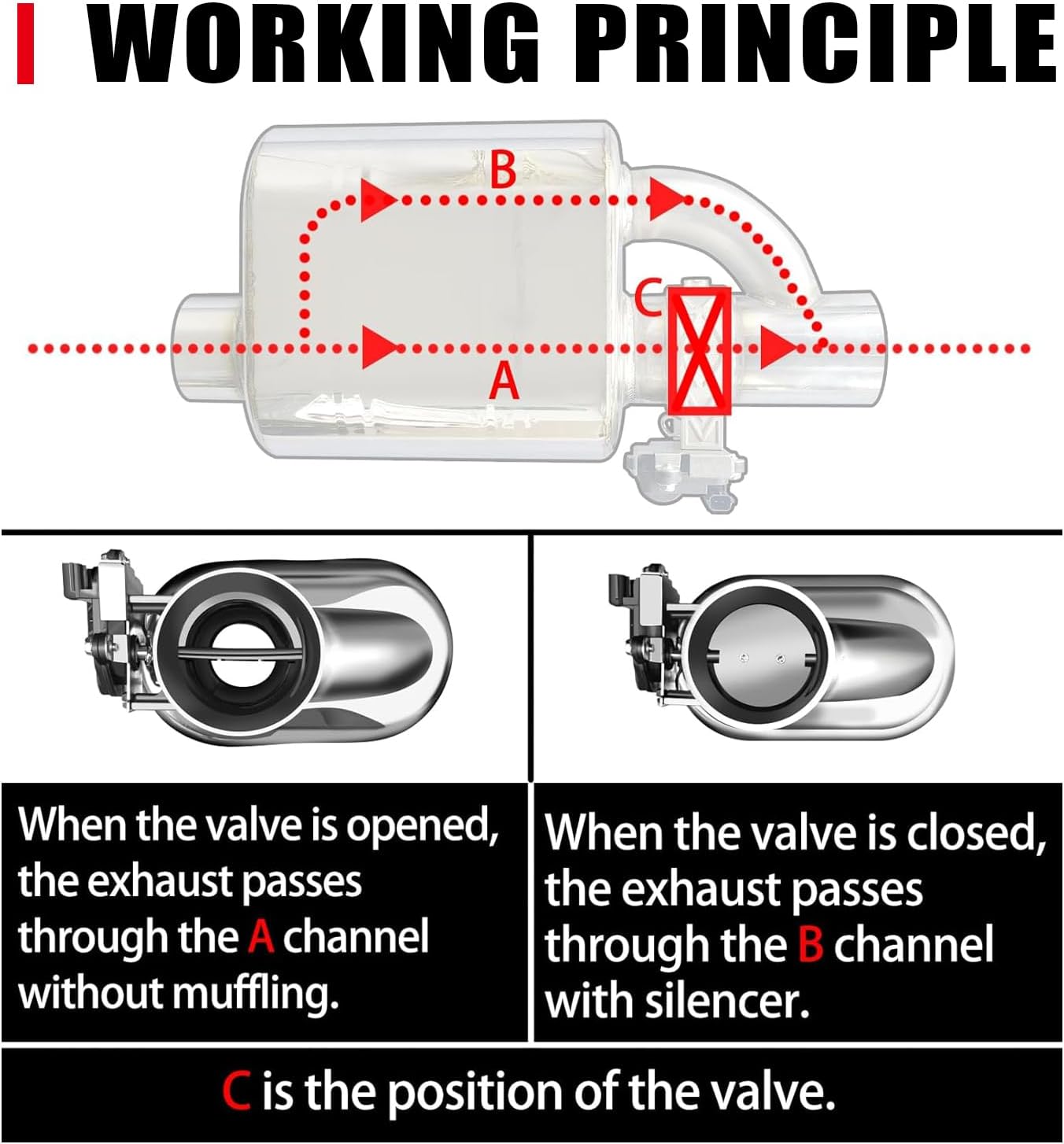
If you’ve ever been stuck in stop-and-go traffic while your loud exhaust system vibrated the rearview mirror off the windshield, you already understand the core problem. A full open exhaust — meaning your engine’s spent gases exit through straight, unrestricted pipes with no muffler in the way — sounds absolutely ferocious at wide-open throttle (WOT, the moment you floor it). But at steady highway cruising speeds, that same setup creates drone: a monotonous, low-frequency resonance that makes long drives genuinely fatiguing. Electric valved exhaust cutout systems solve this by placing a motorized butterfly valve in the exhaust stream. When you want quiet, the valve closes and routes exhaust through your normal muffled path. When you want thunder, the valve opens and gases exit straight to atmosphere — or through a shorter, less restrictive path — bypassing the muffler entirely. This guide will help you pick the right system, size it correctly, wire it cleanly, and understand exactly which trade-offs you’re accepting.
What a Valved Cutout System Actually Does (and Doesn’t Do)
Let’s get the mechanism straight before discussing brands. A cutout is a tee or bypass in your exhaust pipe — usually placed just ahead of the muffler — with a motorized plate inside it. When the motor opens the plate, exhaust gas takes the path of least resistance: straight out through the cutout’s outlet rather than fighting through muffler baffles. The result is a dramatic drop in backpressure (the resistance that slows exhaust flow) and an equally dramatic increase in volume.
What it does well:
- Delivers measurable power gains at high RPM when opened, because reducing backpressure at WOT lets the engine breathe out more efficiently
- Lets you run a quieter muffler for everyday driving without permanently sacrificing open-exhaust character
- Gives you control: most electric systems operate via a dash-mounted switch, a keyfob, or an app — some even integrate with a wide-open-throttle signal from the ECU
What it doesn’t do:
- It does not eliminate all drone on its own. If your muffler already drones at 2,000 RPM, closing the valve just means you’re back to that same drone problem. The cutout only sounds great on the open side.
- It is not a substitute for proper exhaust tuning. Per Engine Labs’ technical reference on exhaust backpressure and power, the relationship between pipe diameter, collector length, and scavenging (the way exhaust pulses help pull fresh charge into the cylinder) means that simply deleting backpressure doesn’t always make peak power — it depends on cam timing, pipe diameter, and RPM range.
- It will not pass a sound ordinance check at a track with strict dB limits unless you keep the valve closed during noise testing. Know your venue’s rules before you build.
Sizing: Get This Wrong and You’ve Bought Yourself a Restriction
Pipe diameter is the single most critical variable. A cutout that’s too small creates a restriction even in the open position — you’ve added a choke point that negates the gains you were chasing.
The standard sizing guidance, echoed consistently across Hot Rod Magazine’s electric cutout coverage and builder forums where verified dyno sheets accompany the discussion, is to match or slightly exceed your current exhaust pipe’s inner diameter:
| Engine output range | Recommended cutout ID |
|---|---|
| Under 300 whp | 2.5 in |
| 300–500 whp | 3.0 in |
| 500–700 whp | 3.5 in |
| 700 whp+ / boosted builds | 4.0 in (dual 3-in setups common) |
For high-boost forced-induction builds specifically, many builders on verified Super Street Online build threads run dual cutouts — one per bank on a V8, or one upstream and one downstream of a single turbo on a 4-cylinder — rather than a single large-diameter unit, because dual smaller gates are easier to package and seal consistently under exhaust heat.
Material matters too. Entry-level cutouts use zinc-alloy or mild-steel bodies. At sustained boost — especially on turbo cars where exhaust temps can exceed 1,400°F on the turbine side — these corrode, warp, and eventually seize. Stainless steel bodies with stainless butterfly plates are the minimum spec for any boosted application. Spend the extra $40–80 upfront; owners who skipped this consistently report valve seizure within 12–18 months on boosted cars, based on aggregated build thread documentation across several enthusiast communities.
Placement, Wiring, and Drone Management
Placement upstream vs. downstream of the muffler: Most street-and-track builds route the cutout outlet downstream of the muffler when they want variable sound, and upstream when they want maximum power gain. Here’s the actual trade-off:
- Upstream placement (before the muffler): When open, exhaust bypasses the muffler entirely — loudest possible sound, maximum potential power gain, but also maximum volume at idle and low speeds. Not practical for daily drivers unless you live somewhere with zero noise enforcement.
- Downstream placement (after the muffler, or at the muffler’s midpoint): When closed, you get your normal muffled tone. When open, exhaust exits through the cutout outlet instead of the muffler’s exit tip — still louder than stock, but the muffler’s internal volume has already absorbed some energy. This is the smart choice for 90% of street builds. Car and Driver’s technical explainer on how exhaust valves work notes that OEM active exhaust systems (like those on Corvettes and Mustang GT500s) use this downstream approach for exactly this reason.
Wiring for a WOT trigger vs. a manual switch: A simple toggle switch on the dash costs nothing extra and works fine. But the real upgrade — especially for autocross and drag applications — is wiring the cutout to open automatically at WOT using a throttle position sensor (TPS) signal or a manifold pressure switch. Most quality electric cutout kits include a relay-based wiring harness; some include a pressure switch that opens the valve above a set boost level. This means you can leave the switch in “auto” mode: quiet on the highway, open at full throttle, no driver input needed.
If you’re running standalone engine management (Haltech Elite, MoTeC M150, AEM Infinity), outputting a switched 12V signal from an ECU auxiliary output to trigger the cutout relay is cleaner and gives you full programmable control over the RPM and load thresholds at which the valve opens. Haltech’s resource library covers auxiliary output configuration in detail; this is a 20-minute calibration task for anyone already comfortable with their ECU’s software.
Addressing drone on the closed side: Here’s the honest part many guides skip: if you have a drone problem with the valve closed, you have a muffler problem, not a cutout problem. The cutout doesn’t fix existing drone — it just gives you an escape route. Motor Trend’s active exhaust system feature article makes this point clearly: factory active exhaust systems are engineered around mufflers specifically tuned for the closed-valve resonance frequency. If you’re building a street car and drone is a genuine concern, evaluate your muffler’s resonance characteristics before adding a cutout. A straight-through design (like a Flowmaster Super 44 or a Borla single-chamber) at the wrong pipe length for your car’s wheelbase will drone with or without a cutout. Chambered mufflers (traditional Flowmaster 40-series, for example) tend to be more forgiving of resonance on varied pipe lengths.
Product Landscape: What’s Worth the Money in 2026
The electric cutout market in 2026 ranges from roughly $80 for basic kits with zinc bodies and minimal sealing, to $350–600 for billet stainless units with weatherproof motors and programmable controllers. Here’s how to think about the tiers:
Entry-level ($80–150): Cast or mild-steel body, single-speed motor, basic toggle-switch wiring harness. Adequate for naturally aspirated builds under 300 whp with modest heat cycles. Owners of these units consistently report satisfactory operation for 18–36 months on NA street cars; longevity drops sharply on boosted cars. Products in this range from brands like Stainless Works entry kits and generic bolt-on sets occupy this space.
Mid-tier ($150–300): Stainless body and plate, weatherproof motor rated for sustained high-temp operation, full wiring kit including relay and pressure switch. This is the sweet spot for boosted street cars and occasional track use. QTP (Quicktime Performance) electric cutouts and Flowmaster’s Force II electric cutout are consistently referenced as reliable options in this range across Hot Rod Magazine’s coverage; owners note solid valve sealing in the closed position and motors that continue operating after sustained heat soak.
Premium ($300–600+): CNC-machined billet stainless, dual-motor designs for positive open/close actuation (rather than spring return, which can fail in high-flow situations), integrated app or ECU control modules. Burns Stainless and Varex Mufflers’ motorized insert systems occupy this tier. For competition drag builds and time-attack cars where a valve that rattles partially open under peak exhaust velocity is genuinely dangerous (risk of unmetered exhaust leak near headers at high boost), the dual-motor positive actuation is the correct spec. Varex’s motorized inserts in particular have appeared in multiple Super Street build features as the choice for builders who want one unit to handle both muffler and cutout function in a single package.
The Decision Rule
Here’s how to cut through the options:
If you’re NA, daily driven, and want occasional open sound on canyon roads: A mid-entry stainless kit ($150–200), downstream of the muffler, manual switch. Size it to your pipe diameter. Done.
If you’re boosted, making 400+ whp, and doing track days alongside street use: Spend $250–350 on a full stainless mid-tier unit, wire it to your TPS or a boost pressure switch for automatic WOT opening, and place it downstream of your muffler. Budget 3–4 hours for installation and wiring.
If you’re building 600+ whp with standalone ECU management and need this to work reliably at the strip or on a time-attack circuit: Positive-actuation billet unit, ECU auxiliary output control, dual cutouts if running a V8 or twin-turbo setup. This is a $500–800 investment in hardware alone, but it’s the only tier that won’t embarrass you in a paddock.
One final check before you buy anything: verify your local sound ordinance and, if you track, your venue’s dB limits. An open cutout at WOT is genuinely loud — think 110+ dB at the pipe on a healthy V8. The ability to close it cleanly is half the product’s value. Make sure yours seals.