June 7, 2026 • Maria Andersen • 9 min reading time • Specs verified June 25, 2026
Universal Intercooler Sizing for Intake Temperature Control: How to Match Core Dimensions to Your Horsepower Target
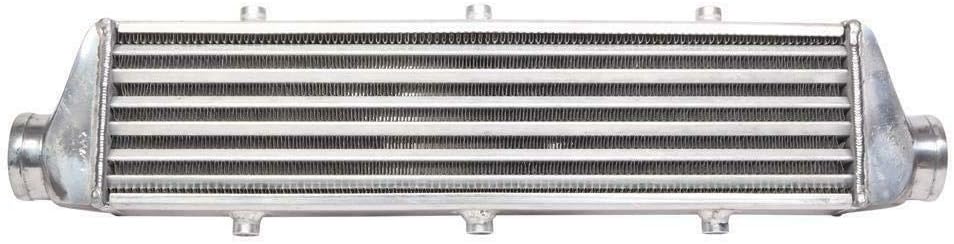
If you’ve ever shopped for an intercooler and found yourself staring at a wall of core dimensions — “24×12×3,” “30×9×4” — without a clear sense of what any of it means for your build, you’re not alone. An intercooler is the heat exchanger that sits between your turbocharger or supercharger and your engine’s intake manifold. Its job is simple in concept: compressed air gets hot when it’s squeezed, and hot air is less dense, which means less oxygen per cylinder, which means less power. The intercooler cools that compressed air back down before it enters the engine, letting you pack more oxygen into each combustion event. Get the sizing right and you pick up real, measurable horsepower and protect your engine from heat-soak detonation. Get it wrong — either too small or unnecessarily large — and you’re leaving power on the table or fighting pressure drop that robs efficiency. This guide gives you a practical sizing framework, the math that backs it up, and a clear decision rule at the end.
Why “Bigger Is Always Better” Is the Wrong Mental Model
The instinct to grab the largest intercooler that will physically fit is understandable — more cooling surface has to be better, right? The reality is more nuanced, and experienced builders know it. Core size is a tradeoff between three competing variables: thermal efficiency (how much heat it removes), pressure drop (how much boost pressure the core itself consumes), and throttle response (how much air volume the system has to pressurize before boost reaches the engine).
Garrett Motion’s technical resource library frames this directly: a core that is too thick relative to its face area will generate high pressure drop across the fins, which means your turbo has to work harder to deliver the same manifold pressure. That extra turbine loading raises exhaust backpressure and hurts spool time. Meanwhile, a core that is too thin — all face area and no depth — may not have enough dwell time for the aircharge to surrender its heat to the fin-and-tube matrix.
Engine Labs’ universal intercooler buyer’s guide puts a useful rule of thumb on it: pressure drop across the core should stay under 1.5 psi at your target airflow rate. Beyond that threshold, you’re trading away boost you paid for. The SAE paper 2003-01-0705 on charge-air cooling systems for turbocharged engines documents this relationship with more precision, showing diminishing thermal returns as core thickness exceeds roughly 4–5 inches for street-and-track duty airflows.
The practical consequence: a well-matched 24×12×3.5-inch bar-and-plate core will outperform a physically larger but poorly matched unit at the same horsepower target — both on the dyno and in real-world heat-soak resistance.
The Sizing Framework: Matching Core Volume to Horsepower
The most reliable starting point is core volume — face area (width × height, in square inches) multiplied by thickness (in inches). This gives you a single number to benchmark against your power goal.
Precision Turbo & Engine’s tech notes, along with data aggregated from builder communities across the forced-induction space, support the following working ranges for a bar-and-plate aluminum core with a medium-density fin pack (the standard for most street and track applications):
By the Numbers — Core Volume vs. Horsepower Target
| Horsepower Target (flywheel) | Minimum Core Volume | Recommended Core Volume |
|---|---|---|
| 300–400 whp | 350–500 in³ | 450–600 in³ |
| 400–600 whp | 600–800 in³ | 750–1,000 in³ |
| 600–900 whp | 900–1,200 in³ | 1,100–1,500 in³ |
| 900 whp+ | 1,400 in³+ | 1,600–2,000 in³ |
Ranges assume a single-pass bar-and-plate core, moderate ambient temperature (75–85°F), and a properly sized turbo operating near its efficiency island. High-heat applications (drag racing, sustained track sessions) should target the upper bound of each range.
To put this in concrete terms: a 24×12×3.5-inch core has a volume of 1,008 cubic inches, which lands it squarely in the 600–900 whp recommended window. A 30×9×4-inch core checks in at 1,080 cubic inches — similar volume, but the geometry matters for packaging. The taller 24×12 configuration tends to offer slightly better face-area-to-thickness ratio for pressure drop, while the 30×9 fits lower front-mount intercooler (FMIC) openings on many platforms.
Face Area, Thickness, and Fin Density: Where the Geometry Gets Practical
Once you know your target core volume, the next step is deciding how to distribute that volume between face area and thickness — and choosing a fin density that matches your airflow and ambient conditions.
Face area is the primary variable for cooling efficiency at higher airflows. A larger face area means more fin surface is exposed to ram air (or fan-driven airflow in a static setup), and the air charge spends more time in contact with the core. Hot Rod Magazine’s intercooler sizing feature notes that for track applications where sustained heat rejection matters more than instantaneous response, maximizing face area is the right priority — even if it means accepting a slightly thicker core to hit your volume target.
Core thickness is where pressure drop lives. The fin-and-tube matrix creates resistance; the longer the airpath through the core, the more boost pressure is consumed. For most street builds targeting 400–700 whp, a thickness of 3 to 4 inches hits the sweet spot. At 4.5 inches and beyond, pressure-drop penalties start accumulating meaningfully unless you’re running very low fin density or a high-flowing fin geometry (offset or louvered fins over straight fins).
Fin density — measured in fins per inch (FPI) — is the most commonly misunderstood variable. Higher fin density increases total surface area and improves heat transfer at lower airflows, but it also increases restriction. The consensus from builder data and Precision Turbo’s tech notes points to 8–12 FPI as the practical range for street and track forced-induction builds. Low-density cores (6 FPI or below) are primarily used in applications where minimum pressure drop is critical — high-horsepower drag builds making multiple short passes. High-density cores (14+ FPI) are better suited to liquid-to-air setups where the coolant loop, not ambient air, is doing the heat transfer work.
Pressure Drop Math: A Quick Sanity Check
You don’t need a flow bench to sanity-check your intercooler selection. A simplified version of the pressure-drop calculation gives you a directional answer in about two minutes.
Airflow through your intercooler scales with horsepower. A reasonable approximation for a gasoline engine with a modern turbo operating near peak efficiency is:
Mass airflow (lb/min) ≈ HP_target × 0.065
At 500 whp, that’s roughly 32.5 lb/min. At 800 whp, you’re looking at 52 lb/min.
Garrett’s technical resource documentation shows that a well-designed 24×12×3.5-inch bar-and-plate core at 32.5 lb/min will produce roughly 0.8–1.1 psi of pressure drop at typical street boost levels (18–22 psi). At 52 lb/min, that same core approaches 1.4–1.7 psi — right at the edge of acceptable, which is exactly why the 600–900 whp range calls for a larger core.
This math also explains why builders sometimes see disappointing dyno numbers after installing an undersized intercooler: they’re losing 1.5–2 psi of effective manifold pressure to core restriction, and compensating by cranking boost higher on the turbo — which adds heat, negates the intercooler’s work, and stresses the compressor.
Ambient Temperature and Heat-Soak: The Variables Most Calculators Ignore
Published core efficiency ratings — typically expressed as a percentage reduction in intake air temperature (IAT) delta versus ambient — are measured under controlled conditions: a specific airflow rate, a specific inlet temperature, and usually a first-pull or first-pass scenario. Real-world performance, especially in track and repeated-run applications, is meaningfully different.
Heat-soak is the intercooler’s accumulated thermal load after sustained use. A core that drops IATs by 80% on the first dyno pull may only achieve 55–60% on the third pull if the core itself has absorbed enough heat to reduce its temperature gradient. Engine Labs’ buyer’s guide documents this degradation pattern and recommends one of two strategies for track builders: oversize the core by 25–30% relative to your calculated minimum (more thermal mass takes longer to saturate), or run a water-methanol injection system downstream of the intercooler as a secondary cooling mechanism.
For daily drivers and weekend builds where heat-soak resistance matters less than packaging and cost efficiency, staying at the calculated minimum-to-recommended range is perfectly defensible. The tradeoff is real, but so is the value of a properly sized core that doesn’t demand premium airflow or a water-meth setup to perform.
Bar-and-Plate vs. Tube-and-Fin: One More Variable to Resolve
Universal intercoolers are available in two primary construction types, and the choice has sizing implications.
Bar-and-plate cores are heavier, more durable, and generally more efficient per cubic inch because the flat internal channels allow tighter manufacturing tolerances and better fin contact. They’re the default recommendation for any build above 350 whp, and virtually every serious build documented in the Precision Turbo tech notes and Engine Labs’ builder coverage uses bar-and-plate.
Tube-and-fin cores are lighter, less expensive, and more prone to damage from debris — but they do offer faster heat dissipation after soak because of their lower thermal mass. For lightweight time-attack builds where weight reduction is a priority and the car is between sessions in a cool paddock, tube-and-fin has a legitimate niche. For everything else, bar-and-plate is the right call.
The sizing math above applies to bar-and-plate. If you’re evaluating a tube-and-fin unit, add roughly 15% to your calculated volume target to get equivalent cooling performance.
The Decision Rule
If you’ve done the math above, you’re ready to spec a core. Here’s the plain-language decision framework:
-
If your target is 300–500 whp and you’re building for a daily driver or weekend street car: a 24×12×3 to 24×12×3.5-inch bar-and-plate core (roughly 864–1,008 in³) covers you with margin to spare. Prioritize packaging fit over chasing extra volume.
-
If your target is 500–750 whp on a street/track dual-duty car: you need at least 900 in³ and ideally 1,000–1,200 in³. A 28×12×3.5 or 30×12×3.5-inch core lands here. Verify pressure drop is under 1.5 psi at your airflow rate before committing.
-
If your target is 750–1,000 whp on a dedicated track or drag car: core volume of 1,200–1,600 in³ is your floor, heat-soak resistance matters, and you should be considering water-meth as a supplement regardless of core size.
-
If ambient temperature or sustained track sessions are a factor at any power level: add 25–30% to your calculated core volume and prioritize face area over thickness in how you distribute that volume.
The intercooler is one of the few components in a forced-induction build where buying slightly larger than calculated costs relatively little and pays dividends in consistency — especially as you turn up boost over time. Treat it as infrastructure, size it for where you’re going rather than where you are today, and the rest of the tuning conversation gets significantly easier.