June 1, 2026 • Maria Andersen • 9 min reading time • Specs verified June 25, 2026
GM 1.4L Turbo Replacement Buyers Guide: Matching Compressor Quality to Your Cruze, Sonic, or Encore Build
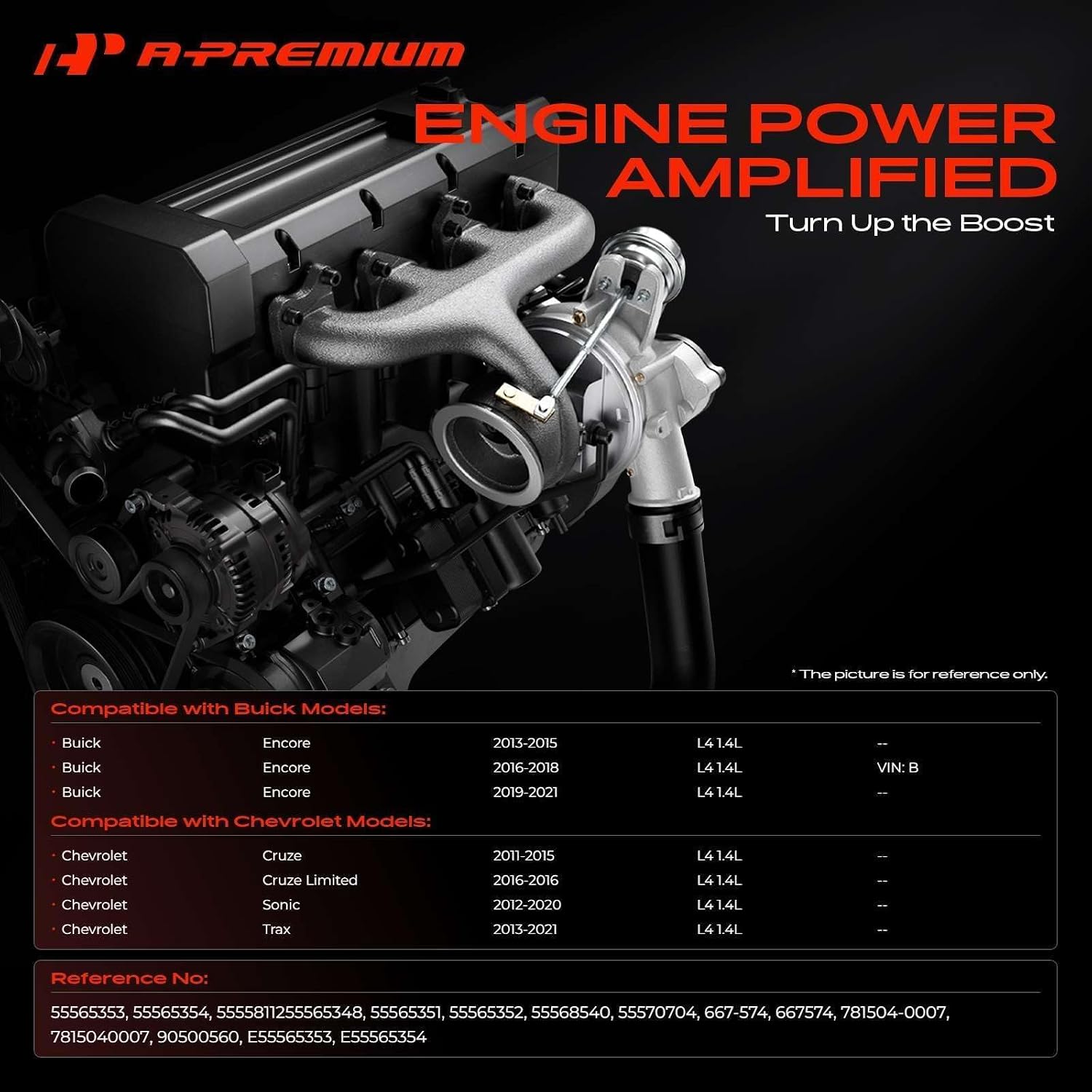
If the turbocharger (the snail-shaped device that pressurizes air into your engine for more power) on your GM 1.4L has called it quits — whether through oil starvation, a broken actuator, or simply 100,000 miles of hard use — you’re standing at a fork in the road. You can bolt back a stock-equivalent unit and resume daily life, or you can spend a little more thoughtfully and come away with something meaningfully better than what GM originally installed. A turbocharger works by spinning a turbine wheel on exhaust gas energy to compress intake air; denser air means the engine can burn more fuel per cycle, producing more power than the displacement alone would suggest. This guide is going to walk you through every tier of replacement available for the Chevrolet Cruze, Sonic, Buick Encore, and their platform siblings — from a $180 remanufactured unit to a $900 upgraded CHRA (Center Housing and Rotating Assembly, the heart of any turbo) — with honest tradeoff framing at every price point. By the end, you’ll have a decision rule that matches your build goals, not just your budget.
Why the Factory 1.4L Turbo Fails — and Why That Context Matters for Your Replacement Choice
Before you spec a replacement, understanding the failure mode shapes the decision. The GM 1.4L LUV/LUJ/LUU family (used in 2011–2019 Cruze, 2012–2020 Sonic, and 2013–2019 Encore variants) runs a Garrett-designed IHI-manufactured unit — a relatively compact turbo with a cast-iron turbine housing, a floating-bearing CHRA, and an integral wastegate actuator. Per GM Service Bulletin PIP5650D, the most common failure modes are:
- Oil coking in the CHRA bearing housing — caused by short-trip driving that never fully heat-soaks and then cools the oil properly. Degraded oil turns to carbon deposits that starve the bearings.
- Actuator rod failure — the wastegate actuator (the device that bleeds off excess exhaust pressure to keep boost in check) uses a pneumatic canister prone to cracking on high-mileage units.
- Compressor wheel contact — often downstream of bearing wear; once radial play develops, the aluminum compressor wheel contacts the housing and induces catastrophic failure.
Why does this matter for your buying decision? If your failure was oil-coking from deferred maintenance, a direct replacement into the same oiling environment will fail the same way. The correct answer there is a replacement plus an oil feed restrictor (typically a 0.030″ restrictor fitting) and rigorous cold-start idle-before-shutdown habits. If your failure was actuator-only, you may not even need a full replacement — the actuator is serviceable on bench.
Car and Driver’s long-term testing notes on the 2016–2019 Cruze flagged the turbo as a “known watch item” after 90,000 miles, particularly in climates with frequent cold starts, which aligns with owner consensus across model-year forums.
The Replacement Tier Map: What You’re Actually Buying at Each Price Point
Tier 1 — Remanufactured OEM-Spec ($150–$280)
These are rebuilt factory units using reconditioned cores. Quality varies wildly. The best remanufacturers — Dorman, BorgWarner Reman, and Standard Motor Products’ BWD line — use new CHRA bearings, rebalance the rotating assembly, and flow-test the wastegate actuator before shipment. The budget importers on the same shelf do not.
By the numbers:
- Factory boost target: ~18–20 psi (1.24–1.38 bar) peak, tapering by redline
- Stock power rating (LUV): 138–153 hp depending on model year
- Reman core charge at most retailers: $50–$80 refundable deposit
- Expected service life of a quality reman: 60,000–80,000 miles with proper oiling
The tradeoff is exactly what you’d expect: a Dorman or BorgWarner reman gets you back to factory spec at the lowest cash outlay. It is absolutely the correct call for a high-mileage daily driver you’re selling in 18 months, or for a Sonic with a blown motor and a tight repair budget. It is not the right call if your goal is more power, you’re doing any track days, or you’ve already modified the intake/exhaust and are consistently running near the top of the factory boost curve.
If X = stock power, budget priority, daily driver with 3 more years on the platform → Tier 1 is your answer.
Tier 2 — OEM-Equivalent New-Build Units ($280–$500)
This is a quietly important category. Several aftermarket manufacturers — most notably Turbonetics’ “OE replacement” line and Mishimoto’s direct-fit Cruze turbo — sell brand-new units built to OEM specification rather than rebuilt from cores. The distinction matters: you get new seals, new bearings, new compressor and turbine wheels, all balanced together as a matched set rather than assembled from reconditioned components.
Mishimoto’s direct-fit unit (released in the 2023 model year, currently in their 2025 catalog for LUV applications) uses a ball-bearing CHRA rather than the factory floating-journal design. Ball-bearing centers (where the shaft rides on races rather than a plain oil film) spool roughly 15% faster per Garrett’s compressor map documentation on comparable frame sizes, and they are demonstrably more tolerant of marginal oiling conditions. That last point is not trivial on the 1.4L given its known coking vulnerability, as noted in SAE Technical Paper 2014-01-1647’s thermal management analysis of small-displacement turbocharged engines.
Owners across aggregated forum reviews consistently report a noticeably sharper throttle response with ball-bearing units compared to the OEM floating-journal design — not more peak power, but a tighter, more immediate mid-range torque delivery.
Tradeoff: You’re paying $100–$200 more than a quality reman. The ball-bearing center justifies most of that premium if you’re keeping the car long-term or if your driving pattern (short trips, cold climates) contributed to the original failure.
If X = keeping the car 4+ years, want better durability than stock, not trying to add power → Tier 2 is your answer.
Tier 3 — Upgraded-Trim Drop-In Replacements ($450–$750)
Here’s where the conversation shifts from “replacement” to “upgrade.” Several tuners and specialty fabricators — including Forced Performance (a division of Borg Warner Turbo Systems) and PTE (Precision Turbo & Engine) — have released drop-in CHRA upgrades that use the factory turbine and compressor housings but install a higher-spec rotating assembly.
The most relevant spec to examine here is the compressor wheel trim — trim is a dimensionless number expressing the ratio of the inducer (inlet) to exducer (outlet) diameter of the compressor wheel. Higher trim wheels move more air volume, shifting the compressor map (a graph of airflow versus pressure ratio, which Garrett’s technical resources explain in accessible detail) toward higher flow rates without necessarily changing the housing. For the 1.4L application, upgraded CHRA units typically run a compressor wheel in the 56–60 trim range versus the factory 52-ish trim, which on a properly tuned map supports 200–230 whp on E85 blends before efficiency falls off.
This is also the tier where you need to think honestly about your ECU (Engine Control Unit — the computer managing fuel and spark). The factory ECU with a quality tune (Trifecta Tune is the consensus recommendation in the Cruze tuning community for street-driven builds) can manage a modestly upgraded compressor wheel without drama. Once you’re targeting 220+ whp, a standalone or piggyback solution becomes a real conversation.
By the numbers (Tier 3 — upgraded CHRA, supporting mods, E85, quality tune):
- Estimated peak: 200–230 whp (manufacturer-rated ranges on supported setups)
- Boost ceiling before housing becomes limiting: ~24–26 psi
- Supporting mod minimum: high-flow intake, cat-back exhaust, upgraded intercooler
- Tune requirement: mandatory — do not run an upgraded wheel on a stock tune
If X = you want real power gains, plan to tune, have supporting mods or are buying them together → Tier 3 is your answer.
Compressor Map Basics: The One Concept That Separates Good Decisions from Expensive Mistakes
You don’t need to be an engineer to use a compressor map, but you do need to understand one thing: every compressor wheel has an island of efficiency — a range of airflow and pressure ratio where it’s doing useful work without generating heat. Push air demand outside that island (by running too high a boost target, or too large an engine for the wheel’s flow range) and you get hot, inefficient charge air that costs you power and risks detonation.
On the 1.4L — a 1.4-liter displacement engine — the stock turbo’s efficiency island sits roughly between 10–22 lbs/min airflow at pressure ratios of 1.8–2.4. Garrett’s technical documentation on similar frame-size units shows upgraded trim wheels (56–60 trim as mentioned above) extending that island toward 24–28 lbs/min, which is meaningful headroom for bolt-ons. Going larger — chasing a wheel sized for a 2.0L application — pushes you off the left edge of the island at part throttle, giving you laggy, unresponsive street manners in exchange for a peak number that only shows up for 2 seconds on a dyno pull.
Engine Labs’ coverage of CHRA design principles reinforces the same point: matching the compressor map to the engine’s actual airflow demand curve is more important than maximizing peak flow capability.
The practical rule: Size your compressor for your realistic boost target plus 10–15% headroom, not for the maximum the housing will mechanically flow.
Decision Framework: The If/Then Matrix
| Your Situation | Right Choice |
|---|---|
| Stock power, selling in 1–2 years, tightest budget | Quality reman (Dorman, BorgWarner reman), Tier 1 |
| Keeping long-term, same power goals, better reliability | New-build ball-bearing OE-spec (Mishimoto, Tier 2) |
| Planning tune + bolt-ons, targeting 180–230 whp | Upgraded CHRA drop-in + intake + intercooler + tune, Tier 3 |
| Chasing 250+ whp, considering E85, track use | Tier 3 CHRA minimum, Haltech or similar standalone ECU conversation |
| Actuator failed but compressor spins freely | Actuator-only replacement — don’t buy a full turbo |
One final note on installation labor: a shop flat-rate for this swap typically runs 3.5–5 hours, heavily dependent on whether the downpipe hardware comes off cleanly. Budget $400–$600 in labor if you’re not doing it yourself, and consider that in your tier math. A $280 Tier 2 unit with $500 in labor and a $250 tune is a $1,030 all-in job — which changes the relative value calculus versus going straight to Tier 3 while you have the car apart.
Make the decision once. Buy to your actual goal, not to the minimum that gets you moving.