May 2, 2026 • Maria Andersen • 9 min reading time • Specs verified June 25, 2026
Supercharger Kits for Serious Builds: Roots Blowers, Whipple Centrifugals, and What Your Fuel System Needs to Keep Up
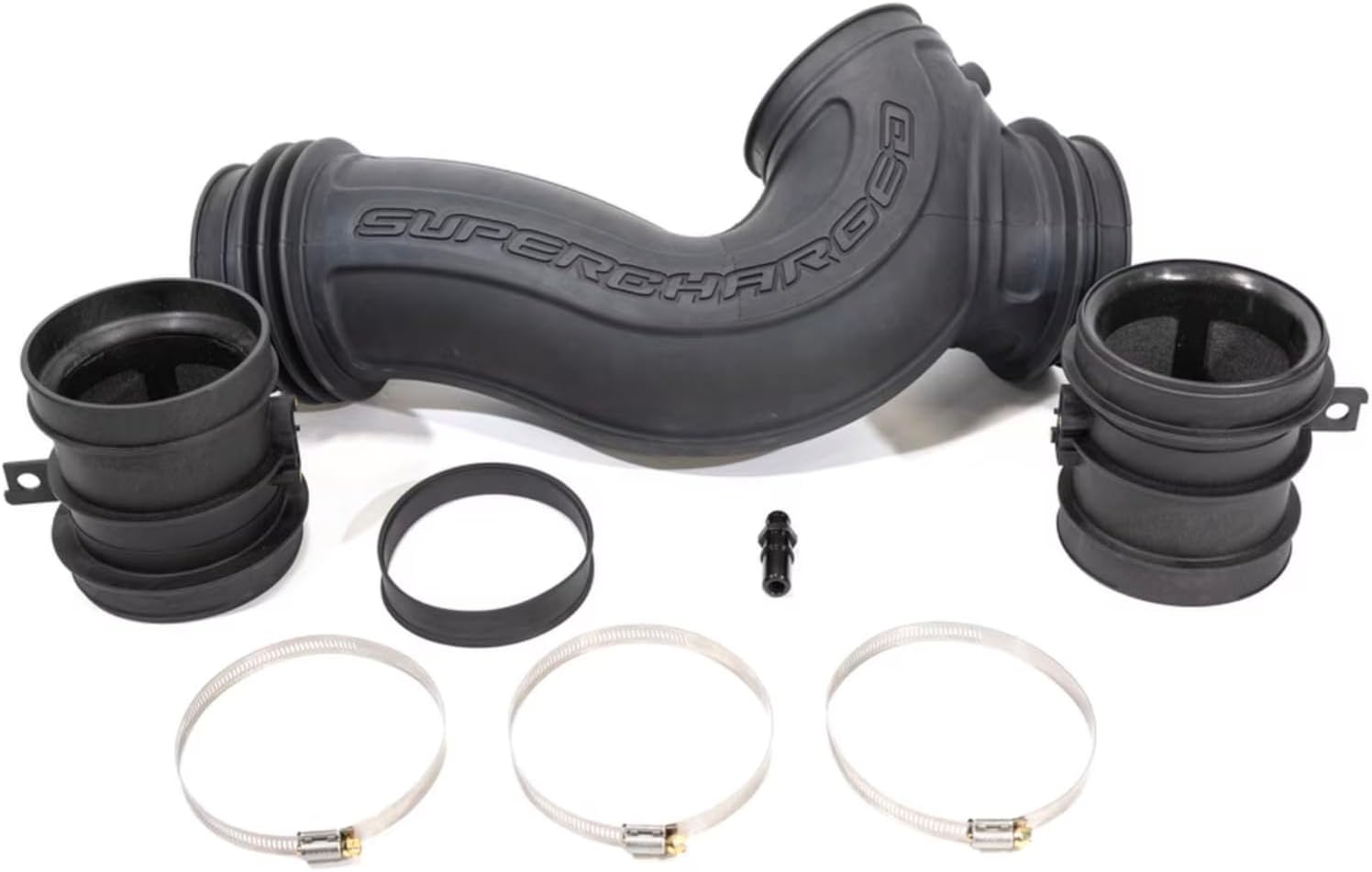
A supercharger is, at its simplest, an air pump bolted to your engine. Your engine makes power by burning a mixture of fuel and air — the more air you can pack into each cylinder, the more fuel you can add, and the bigger the combustion event. A supercharger compresses that incoming air and forces more of it into the engine than it could inhale on its own. Unlike a turbocharger (which is driven by exhaust gases), a supercharger is driven mechanically — usually by a belt off the crankshaft — which means it starts boosting the moment you press the accelerator, with no waiting for exhaust flow to spool up. That’s the core appeal. But “supercharger” is an umbrella term covering three meaningfully different designs — Roots, twin-screw, and centrifugal — and the wrong choice for your build can leave real power on the table, stress your fuel system beyond its limits, or simply not fit your power goals. This guide gives you the framework to make that call confidently.
| EDITOR'S PICK[Roush Supercharger Kit 650Hp Ph…](https://www.amazon.com/dp/B07GT1PQTW?tag=greenflower20-20) | Mid-tier[Chevrolet Performance 12622236…](https://www.amazon.com/dp/B019XEU9B8?tag=greenflower20-20) | Budget pick[ACDelco GM Original Equipment 1…](https://www.amazon.com/dp/B000QIR2ZC?tag=greenflower20-20) | |
|---|---|---|---|
| Horsepower | 650 hp | — | — |
| Engine fit | 5.0L F-150 18-19 | — | — |
| Type | — | ZL1 Upgrade Kit | Synthetic Oil |
| Capacity/Volume | — | — | 4 oz |
| Part type | Supercharger Kit | Upgrade Kit | Oil |
| Price | $9,713.46 | $2,080.99 | $14.84 |
| See on Amazon → | See on Amazon → | See on Amazon → |
Roots, Twin-Screw, and Centrifugal: What Each Design Actually Does
Understanding the mechanical difference between these three isn’t trivia — it directly shapes your power curve, your tune, and how much you’ll spend supporting the build downstream.
Roots blowers (think the classic Weiand 6-71 on a blown big block, or the modern Eaton TVS series used in factory Dodge Hellcats and Edelbrock E-Force kits) work by trapping air between counter-rotating lobes and moving it from the inlet to the outlet without compressing it internally. Compression happens when that air gets pushed into the intake manifold against back-pressure. The result is an extremely fast boost response — essentially full boost the moment the throttle opens — with a characteristically linear power curve. Roots blowers run hot at high boost levels because their internal inefficiency generates significant heat in the charge air, which is why an intercooler (a heat exchanger that cools the compressed air before it enters the engine) is almost always mandatory above 8–9 PSI. Eaton’s TVS (Twin Vortices Series) rotor design, documented in Eaton’s TVS Supercharger Technology Overview, improves on older Roots geometry by adding a four-lobe twisted rotor profile that recovers some internal compression efficiency — owners consistently report intake air temperatures meaningfully lower than equivalently boosted older Roots designs.
Twin-screw superchargers (Whipple’s 2.9L and 4.5L units being the category benchmarks) look similar externally to Roots blowers but operate on a different principle: their interlocking helical rotors actually compress the air internally before discharge, much like a small rotary compressor. The Whipple Technical FAQ describes this as “internal compression ratio,” and it matters because internally compressed air runs cooler and the design is more thermodynamically efficient. Practical payoff: twin-screws typically need less aggressive intercooling to hit the same charge temps, and they produce more torque at lower RPM than a comparably sized centrifugal unit. The tradeoff is cost — Whipple’s complete kit for a Coyote 5.0 Mustang runs in the $3,200–$4,800 range depending on trim level — and the physical envelope, since twin-screw units are tall and require hood clearance consideration.
Centrifugal superchargers (Vortech, Paxton, ProCharger) work like a turbocharger’s compressor section but are driven by a crankshaft belt. A small impeller wheel spins at extremely high RPM — Vortech’s V-3 Si-Trim documentation lists impeller speeds up to 55,000 RPM — and flings air outward to build boost. Because boost output is proportional to impeller speed, and impeller speed is proportional to engine RPM, centrifugal units produce a power curve that climbs with RPM: relatively modest boost and torque down low, peaking hard at redline. This makes them the darling of high-RPM engine combinations and track builds where you’re spending most of your time above 5,000 RPM. They’re also compact, run cool (most owners report the lowest charge temps of any supercharger type at equivalent boost levels), and generally the least expensive way into forced induction — Vortech V-3 Si-Trim self-contained kits regularly land in the $2,100–$2,900 range. The honest tradeoff: if your build is a street car doing most of its work below 4,500 RPM, you’ll feel underwhelmed at stoplight pulls.
By the Numbers: Boost Profile Comparison at Equal Crank HP Target (~600 RWHP, V8 Platform)
| Type | Typical Boost at 2,500 RPM | Typical Boost at 6,000 RPM | Kit Cost Range (installed) | Intercooler Required? |
|---|---|---|---|---|
| Roots (Eaton TVS) | 8–10 PSI | 10–12 PSI | $2,500–$4,500 | Yes, almost always |
| Twin-Screw (Whipple) | 9–12 PSI | 12–15 PSI | $3,200–$5,500 | Recommended, often included |
| Centrifugal (Vortech/ProCharger) | 2–4 PSI | 12–16 PSI | $2,100–$3,800 | Highly recommended at 10+ PSI |
Figures represent aggregated data from Hot Rod Network’s supercharger shootout feature and manufacturer specification sheets. Actual numbers vary with displacement, camshaft, and tune.
What Your Fuel System Actually Needs — and the Math Behind It
This is where a lot of intermediate builders get caught. The supercharger bolts up clean, the dyno session books fine, and then the tuner comes back with a problem: the injectors are at 95% duty cycle (meaning they’re open nearly the entire engine cycle, leaving no margin for the fuel system to react to transient demands) or the fuel pump is cavitating (losing prime and pressure) under sustained wide-open throttle. Neither is a small problem. Lean conditions under boost damage pistons fast.
The Engine Labs guide on fuel injector sizing and duty cycle math for forced induction lays out the standard formula clearly: Required injector flow rate (lb/hr) = (Target HP × BSFC) ÷ (Number of injectors × Maximum safe duty cycle). BSFC — brake specific fuel consumption — is essentially how many pounds of fuel the engine burns per hour per horsepower of output. For a naturally aspirated gasoline engine, 0.50 is a reasonable BSFC estimate. Under boost, you’re typically working with 0.55–0.60, and if you’re running E85 (ethanol blend fuel, which requires roughly 30–40% more fuel volume than pump gasoline for the same power output), BSFC jumps to 0.70–0.80.
A worked example: You’re targeting 650 flywheel horsepower on a supercharged LS3 (8 cylinders) running 93-octane pump gas. Maximum safe injector duty cycle is 80% — anything above that and you’ve lost your safety margin.
- Required flow = (650 × 0.58) ÷ (8 × 0.80)
- Required flow = 377 ÷ 6.4
- Required flow ≈ 59 lb/hr per injector
A stock LS3 runs 42 lb/hr injectors. You’re already 40% undersized before the supercharger even makes peak boost. This is why injector upgrades — 60 lb/hr Delphi or Bosch units are popular in this power range — show up as line items in every serious supercharger build budget.
On the pump side: your fuel pump must sustain adequate pressure (typically 58–65 PSI on a returnless EFI system) at full-throttle flow volume. Stock fuel pumps are sized for stock fuel demands. At 650+ HP, a single in-tank pump upgrade — a Walbro 450 or comparable high-flow unit rated at roughly 450 liters per hour — is the standard starting point. Above 800 HP on E85, dual-pump setups or external lift pumps (Aeromotive, DeatschWerks) enter the conversation. These aren’t optional upgrades; they’re the structural foundation your tune depends on.
One more variable that the build plan needs to account for before selecting injectors: fuel rail pressure scalability. Some OEM fuel rails at higher boost levels experience a drop in effective injector pressure differential, which shrinks the injector’s actual flow rate below its rated spec. If your supercharger setup is building more than 15 PSI of manifold boost, confirm with your tuner whether a rising-rate fuel pressure regulator or a returnless-to-return conversion is on the table.
Matching the Kit to Your Build Goals — the Decision Frame
Here’s where the intermediate-to-practitioner gap usually lives: buyers select a supercharger for the headline horsepower number and underspec the supporting cast, or they select the wrong boost curve for their actual use case.
If your build is a street/strip dual-purpose car that needs to feel fast everywhere: A Roots or twin-screw kit is your answer. The flat, full-torque boost curve turns every traffic-light gap and on-ramp into a usable event. Edelbrock E-Force kits for popular GM and Ford platforms combine the TVS rotor package with an integrated intercooler and are spec’d to work within stock tune parameters up to their rated output — useful if you’re deferring a standalone ECU. Whipple’s kits step up the output ceiling and include their own inlet manifold and heat exchanger, making them the preferred choice among builders targeting 700–900+ RWHP on the street.
If your build is track-focused or high-RPM oriented: A centrifugal setup from Vortech or ProCharger matches your power-delivery needs and your budget. The Vortech V-7 YSi compressor map (available in Vortech’s technical documentation) shows flat efficiency across a wide RPM band at high flow rates, which matters when you’re spending a lap at sustained 6,500–7,500 RPM. These systems are also easier to package in tight engine bays and add minimal weight.
If you’re on E85 or building toward E85 compatibility: Size your injectors and fuel pump for E85 from the start, even if you’re launching the build on 93. Retrofitting fuel system components after the supercharger is already tuned costs more in labor and downtime than spec’ing it correctly once. Engine Labs’ fuel flow guide specifically flags this as the most common and most preventable mistake in forced-induction builds.
If you’re uncertain about ECU compatibility: Both Roots and twin-screw kits from Edelbrock and Whipple publish compatibility matrices for supported factory ECU platforms (mostly GM E38/E67 and Ford PCM families). If your vehicle falls outside those matrices — or you’re running a non-OEM engine combination — budget for a standalone ECU from Haltech or AEM before the dyno session, not after. Haltech’s resources section covers boost control integration with their Elite series ECUs in detail, and it’s worth reading before you finalize the manifold and bypass valve plumbing.
The underlying decision rule is straightforward: if you want torque everywhere and a streetable tune, buy displacement (Roots/twin-screw) and budget accordingly for fuel. If you want peak-power efficiency and a track-oriented curve, buy a centrifugal and size your fuel system for what the compressor map says it’ll deliver at redline — not what your current injectors were built for. Either way, the supercharger is the headline and the fuel system is the contract. Sign both before you book the dyno.