June 8, 2026 • Maria Andersen • 11 min reading time • Specs verified June 25, 2026
Exhaust Headers for LS Swaps and GM V8 Trucks: Shorty vs. Long-Tube, Stainless vs. Coated, and What the Fitment Charts Miss
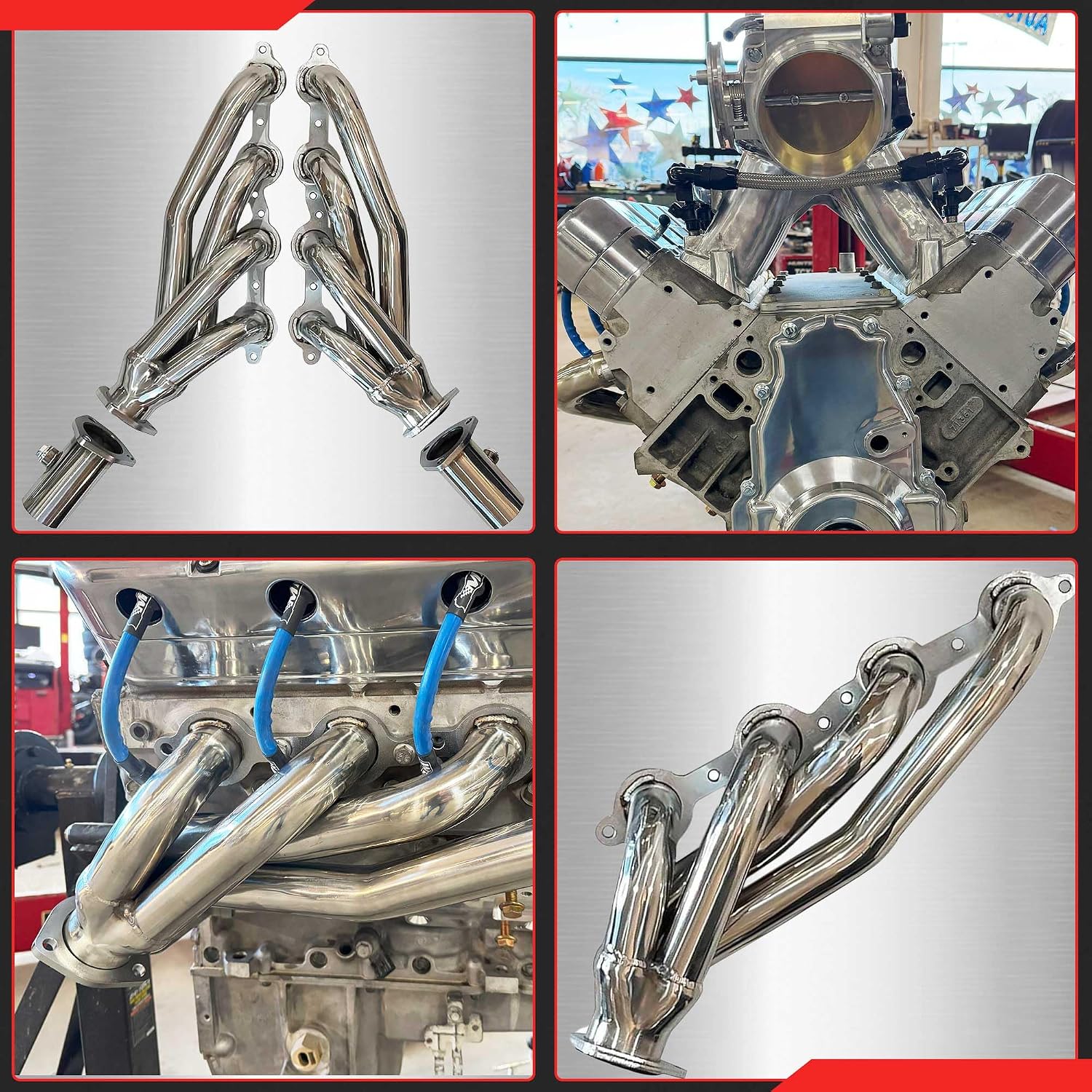
If you’ve ever stood in front of a GM V8 engine bay holding a header catalog and thought, these all look the same until I try to install them — this guide is for you. Exhaust headers are the pipes that bolt directly to your engine’s cylinder head and collect exhaust gases before routing them into a single outlet pipe. Unlike the stock exhaust manifolds that come on most trucks and LS-swapped vehicles — which are short, compact cast-iron pieces designed to fit tightly in a crowded engine bay — aftermarket headers are engineered to flow more exhaust gas, faster, which frees up horsepower your engine was already generating but couldn’t fully use. The tradeoff is that different header designs make power in different ways, cost very different amounts, and fit (or don’t fit) very differently depending on your specific application. This guide breaks down the real decision points: shorty versus long-tube, stainless versus coated steel, and the fitment landmines the manufacturer charts consistently gloss over.
Shorty vs. Long-Tube: This Is the Decision That Matters Most
This is the fork in the road, and it’s worth getting right before you spend a dollar on anything else.
Shorty Headers: Street-Friendly Gains with Manageable Fitment
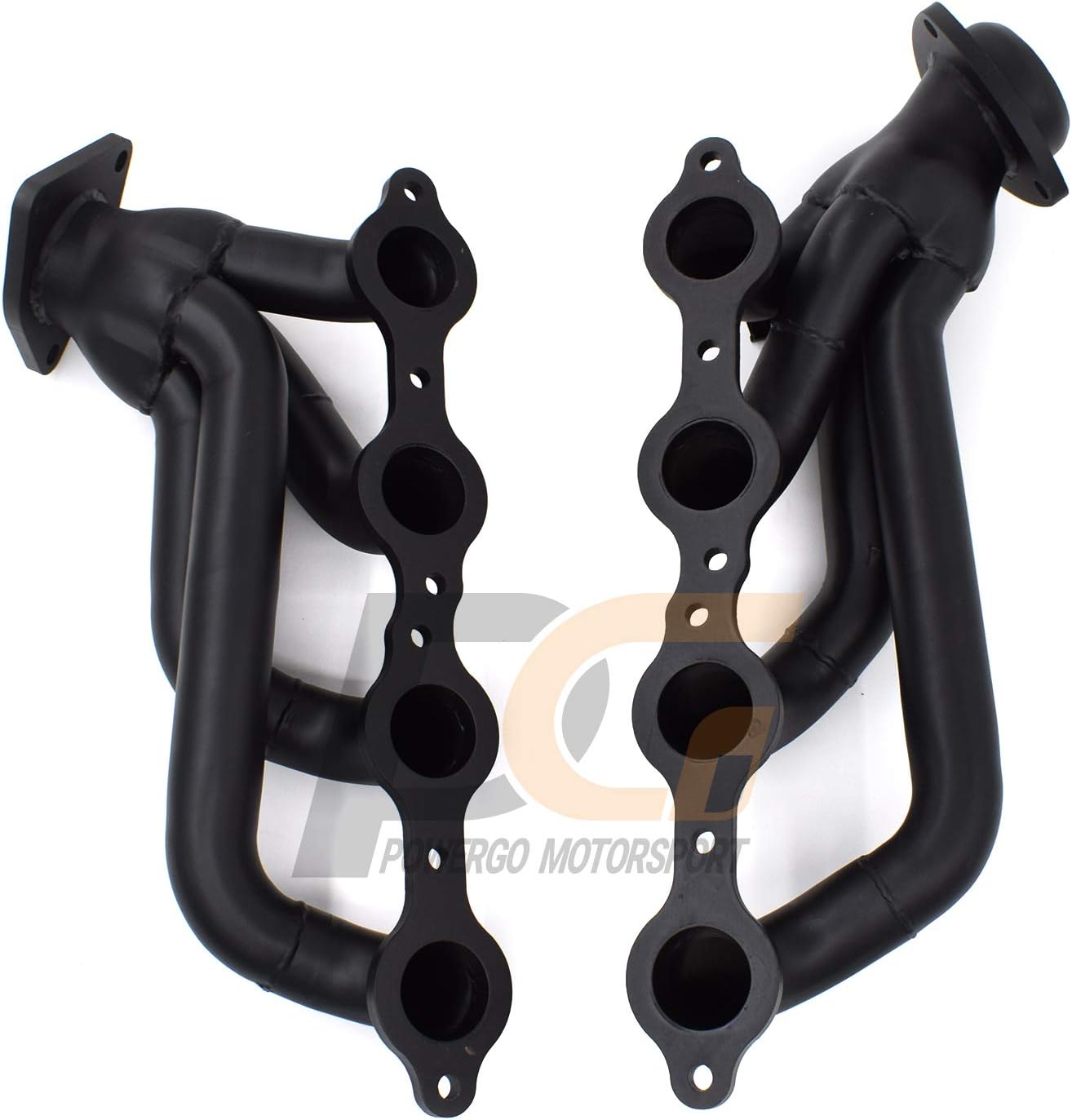
Shorty headers — sometimes called “short-tube” or “block-hugger” headers — use primary tubes (the individual pipes coming off each exhaust port) that are typically 12 to 18 inches long before they merge into a collector. They’re designed to retain the tight footprint of stock manifolds. On a daily-driven GM truck or a streetable LS swap into a first-gen Camaro or S10, shorties are often the only realistic option because the firewall, steering rack, or A/C lines simply won’t clear a longer tube. Power gains are real but modest: most owner-reported and manufacturer-published figures put shorty headers at 10–20 rear-wheel horsepower over cast-iron manifolds on a naturally aspirated LS. That’s legitimate, usable power, but it’s coming primarily from improved port matching and reduced restriction rather than exhaust scavenging.
 product image](/images/external/235de759ccfc.jpg)
Foneso
$12.79
In stock on Amazon
Check price on AmazonLong-Tube Headers: Maximum Scavenging, Maximum Commitment
Long-tube headers use primary tubes that run 28 to 36 inches — sometimes longer on race builds — before merging. That extra length is the whole game. Exhaust gases exiting a cylinder create a pressure wave that travels down the primary tube. When that wave reaches the collector and reflects back, it arrives as a low-pressure pulse — a vacuum, essentially — that arrives at the exhaust port just as the next exhaust stroke begins. This is called scavenging: the outgoing pulse literally helps pull the next charge of exhaust gas out of the cylinder, improving cylinder filling and, by extension, power output. The length of the primary tube determines which RPM range that scavenging effect is tuned for, which is why Engine Labs’ coverage of header design and exhaust flow describes long-tube header engineering as fundamentally an RPM-targeting exercise. SAE International Technical Paper 2003-01-0941, “Exhaust System Tuning for Maximum Volumetric Efficiency,” similarly frames primary tube length selection around peak volumetric efficiency at a target engine speed.
Published manufacturer dyno data and LS swap owner builds aggregated by Hot Rod Magazine in their LS swap header coverage suggest long-tube headers typically deliver 25–40 rear-wheel horsepower over stock manifolds on an otherwise stock LS — and significantly more on built engines with cam upgrades, where the RPM range shifts upward and scavenging effects compound with improved camshaft timing events.
The practical catch with long-tubes: they almost always require modifying or deleting your catalytic converters, which can create emissions inspection problems, ground clearance issues on trucks with lower ride heights, and heat management challenges near the transmission tunnel. On an LS swap, long-tubes also frequently require custom mid-pipe work because the collector drops into a different location than factory. Budget at least $300–600 in additional mid-pipe and flex-joint fabrication if you’re going long-tube on a non-OEM swap chassis — a line item that disappears from most fitment charts.
Exhaust
$198.09
In stock on Amazon
Check price on AmazonRace and Step-Tube Long-Tubes: Track-Only Territory
Step-tube or race-length long-tube headers use primary tubes running 34 to 42 inches and sometimes incorporate a step increase in tube diameter partway along the primary to broaden the scavenging RPM window. These are purpose-built for engines that spend sustained time above 6,000 RPM — dedicated drag builds, road-race LS swaps, and high-compression naturally aspirated builds where every cylinder-filling event matters. Catalytic converter compatibility is effectively zero, and installation in any road-legal vehicle requires careful planning around emissions regulations. Engine Labs’ technical coverage of step-header design notes that the secondary tube diameter increase can extend the effective scavenging band by 800 to 1,200 RPM compared to a straight-tube design of equivalent primary length — a meaningful advantage on a high-revving built engine but irrelevant on a stock-cam truck.
 product image](/images/external/37c053fcefd3.jpg)
BBK
$329.99
In stock on Amazon
Check price on AmazonBy the Numbers
| Header Type | Typical Primary Length | Expected RWHP Gain (Stock LS) | Cat Compatibility | Price Range |
|---|---|---|---|---|
| Shorty | 12–18 in | 10–20 hp | Retains OEM cats | $250–$550 |
| Long-Tube (street) | 28–34 in | 25–40 hp | Requires aftermarket or delete | $450–$950 |
| Long-Tube (race/step) | 34–42 in | 35–55+ hp | Delete or high-flow race cats | $700–$1,400+ |
Stainless vs. Coated Mild Steel: Don’t Buy on Price Alone
Material selection is the second major decision, and it’s less about prestige than it is about your specific use case and how much you hate doing the same job twice.
Mild steel with a ceramic or thermal coating is the entry point for most header builds. Brands like Doug Thorley, Hedman, and Hooker offer coated mild-steel headers in the $250–$500 range for common LS and GM truck applications. The coating — typically a high-temp ceramic applied at the factory — provides decent corrosion resistance and keeps radiated heat down in the engine bay. What owners consistently report, however, is that the coating’s lifespan depends heavily on installation quality: any nick, scratch, or area where moisture intrudes before coating becomes an accelerated corrosion site. In humid climates or on vehicles that see road salt, builders running coated mild steel commonly report surface rust appearing within three to five years, even with careful maintenance. Motor Trend’s GM truck performance coverage has noted this pattern in their long-term testing of truck exhaust upgrades. For a race-only or dry-climate build, coated mild steel is perfectly sensible. For a year-round driver in the Midwest or Northeast, it’s a false economy.
304 stainless steel — the standard alloy used by Kooks, American Racing Headers, Stainless Works, and similar premium manufacturers — is a different proposition. Stainless doesn’t rely on a coating to resist corrosion; the chromium content in the alloy forms a passive oxide layer that self-repairs when scratched. Stainless headers cost more: typically $600–$1,400 for quality LS fitments, and considerably more for custom or compound configurations. Owners on long-run builds consistently report that a quality stainless header looks nearly as good at 80,000 miles as it did at installation — which matters if the engine bay is on display or if you’re building something you intend to drive for a decade.
316 stainless is sometimes specified for forced-induction builds or high exhaust gas temperature applications. It has slightly better corrosion resistance than 304, particularly to chlorides, but the real reason to consider it on a boosted build is thermal stability under sustained high-EGT conditions. Engine Labs’ coverage of forced-induction header materials notes that EGTs on a turbocharged LS running aggressive timing or leaner air-fuel ratios in high ambient temperatures can stress 304 at collector weld joints over extended use.
Inconel appears in serious race applications — time-attack cars, high-boost drag builds — and is priced accordingly (often $2,000 or more for raw material alone). For the vast majority of readers here, 304 stainless is the correct call if budget allows; coated mild steel if you’re running a tight budget on a climate-controlled or dry-climate build.
What the Fitment Charts Miss (and Where Builds Actually Go Wrong)
This is the section that earns its keep. Manufacturer fitment charts are a necessary starting point, not a guarantee.
Oil pan conflicts. The single most common tech-line call for LS swaps is a header primary tube contacting the oil pan. The LS engine family uses different oil pans depending on original application — truck pans, F-body pans, Corvette pans, and swap-specific pans from companies like Hamburger’s and Canton all have different sump configurations. A header listed as fitting an “LS swap into 1967–69 Camaro” is almost certainly spec’d against a specific oil pan. If your pan is different, the number five or six primary tube will likely contact the sump. The fix is either a different header or a different pan. Verify which pan is on your engine before ordering, and cross-reference with the manufacturer’s tech support line — not just the fitment chart.
Steering shaft clearance. On C10 trucks and first-gen F-bodies, the steering shaft runs through the driver’s side of the engine bay in close proximity to where long-tube primaries want to live. Headers listed as fitting a 1969 Camaro with power steering may still require either a retrofit steering shaft — the Flaming River and ididit units are commonly used in LS swaps for exactly this reason — or a spacer modification. If you’re running the original steering column in a classic truck swap, verify clearance with a mockup piece or contact the manufacturer with your specific column type before purchasing.
Y-pipe and mid-pipe drop point. Long-tube headers on LS-swapped trucks often dump the collector into a location that doesn’t align with either the OEM crossover pipe or common aftermarket cat-back systems. Measuring the collector-to-floor distance and collector centerline position before purchasing can save a custom fabrication bill. Some header manufacturers — Kooks and Hooker LS swap kits specifically — publish collector positioning dimensions in their spec documents, which is worth requesting before purchase.
Oxygen sensor bung placement. Trucks and cars subject to emissions testing need O2 sensor locations that the ECM can read accurately. Long-tube headers on a returning street car often relocate the bungs far enough downstream that the sensors read cold and the ECM trips a fault code. Wideband users building for tuning purposes can manage this with bung placement on the mid-pipe, but for a daily driver on a factory tune, verify that your chosen header’s bung locations are compatible with your ECM’s sensor distance requirements. Haltech’s oxygen sensor placement guidelines, published in their installation resources at haltech.com/resources, provide recommended bung-to-collector distances that are directly applicable even when running a stock GM ECM — the underlying sensor physics don’t change with ECU brand.
Decision Rules to Walk Away With
Here’s where the research resolves into a clear framework:
If you’re building a daily-driven GM truck or a street LS swap in a northern or humid climate with emissions requirements → buy 304 stainless shorty headers and retain your catalytic converters. Brands like Kooks, Hooker LS swap shorties, or American Racing Headers offer fitment-verified options in the $500–$800 range that will outlast coated mild steel by years in adverse conditions. The 10–20 hp gain is real and repeatable, the fitment is manageable, and you won’t be chasing leaks or corrosion at 60,000 miles.
If you’re building a dedicated track car, drag car, or high-power street/strip LS with a cam upgrade and no emissions requirements → long-tube headers in 304 stainless are the correct investment. Budget $700–$1,100 for the headers, $300–$600 for mid-pipe and flex joints, and plan for a tune. The scavenging gains compound with camshaft upgrades in a way that shorties cannot match, and on a built engine making power above 5,500 RPM, the dyno delta between shorty and long-tube widens meaningfully.
If your budget is under $400 and this is a daily-driver build in a dry climate → coated mild steel shorties from Hedman or Doug Thorley are not a wrong answer. Understand the corrosion timeline, inspect annually, and treat it as a first step you’ll upgrade when the budget allows.
If you’re planning any boost → buy stainless now and size your primary tubes for your target RPM range after turbo or supercharger selection, not before. Engine Labs’ coverage of forced-induction header design notes that boosted applications frequently benefit from slightly shorter primary tubes than equivalent naturally aspirated builds, because the turbo’s turbine housing and exhaust backpressure characteristics interact with the scavenging wave differently than open atmosphere does. Ordering based on a naturally aspirated fitment recommendation without accounting for your specific turbo A/R ratio leaves power on the table from the start.
The fitment charts are the beginning of the conversation. The build details are where the actual decision lives.