June 10, 2026 • Maria Andersen • 9 min reading time • Specs verified June 25, 2026
Cold-Air Intakes for Full-Size Trucks: Real Dyno Numbers, Real Drone Risk, and Which Kit Actually Fits Your Build
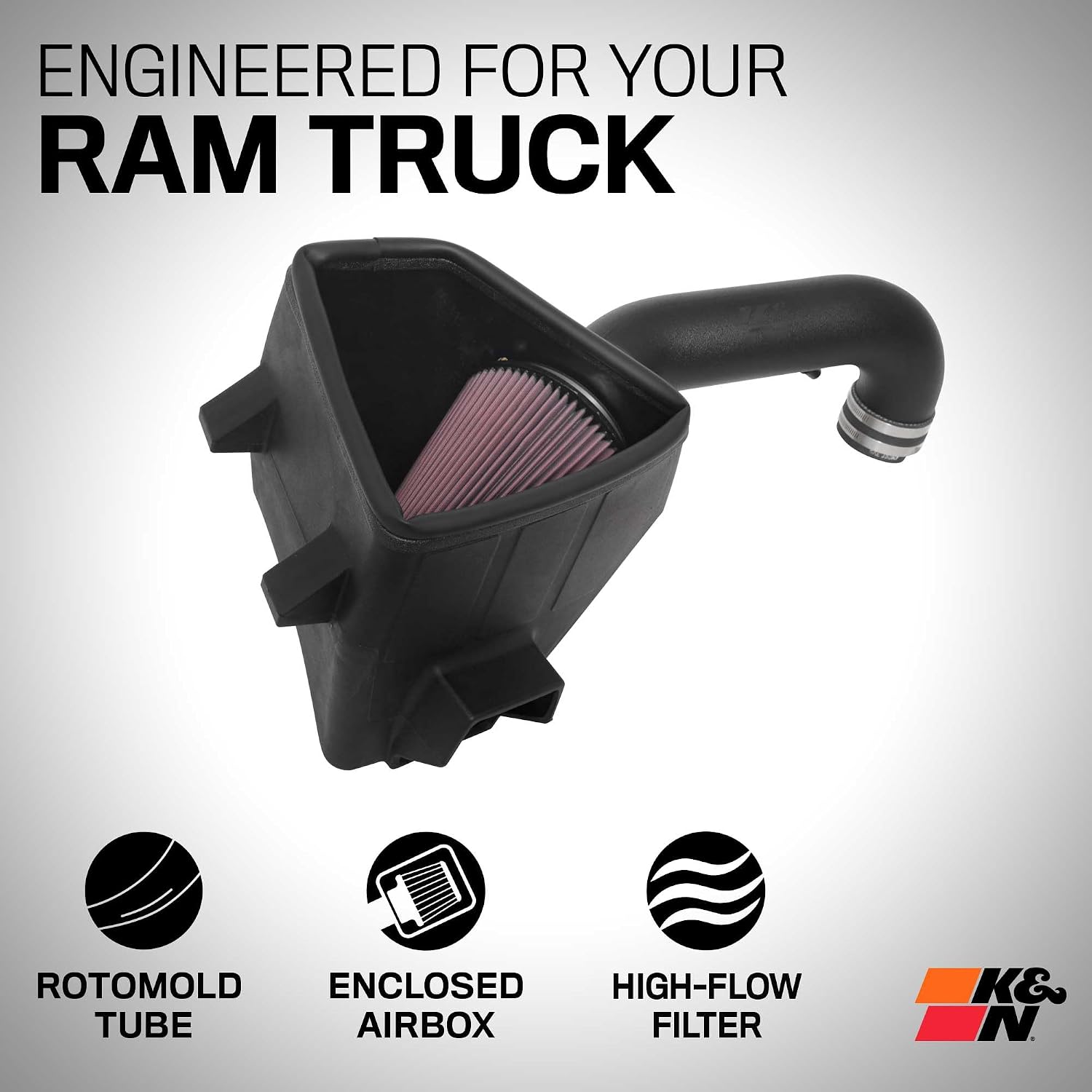
If you’ve been shopping intake kits for your truck and found yourself buried in manufacturer claims — “up to 27 horsepower!” printed in bold on a box — you’re not alone. A cold-air intake is exactly what the name says: a system that replaces your truck’s factory airbox with a larger-diameter tube and a free-flowing air filter, routed to pull in cooler, denser air from outside the engine bay rather than hot air sitting near the exhaust manifold. Cooler, denser air means more oxygen per combustion event, and more oxygen means the engine can burn more fuel and make more power. Simple concept. The complicated part is figuring out how much real-world power a given kit actually produces on your engine, whether it’ll create an annoying intake roar at highway speeds, and whether it’ll survive a rainstorm without hydrolock (when water gets sucked into the engine — an expensive, engine-killing event). This guide cuts through the marketing noise using published dyno sheets, owner consensus, and fitment data across the most popular full-size truck platforms. By the end, you’ll have a clear decision rule for your build.
| EDITOR'S PICKK&N Cold Air Intake System: Hig… | Mid-tierK&N Cold Air Intake System: Hig… | Budget pick[Rough Country Cold Air Intake f…](https://www.amazon.com/dp/B07PJRXQ3J?tag=greenflower20-20) | |
|---|---|---|---|
| Filter Type | High-Flow | High-Flow | — |
| Vehicle Fit | 2019-2026 RAM 1500 | 2014-2020 Chevy/GMC/Cadillac 1500 | 2014-2018 Chevy/GMC 1500 |
| Engine | — | — | 5.3L/6.2L |
| Construction | Roto Molded | — | — |
| Price | $369.99 | $317.99 | $129.95 |
| See on Amazon → | See on Amazon → | See on Amazon → |
What the Dyno Sheets Actually Show (and What They Don’t Tell You)
Let’s start with honest math. The gains you’ll see quoted on intake packaging are almost always peak-to-peak numbers taken at wide-open throttle on a dyno — meaning the absolute best conditions possible. Real-world gains at partial throttle, in traffic, hauling a load? Smaller.
By the numbers — published dyno gains, naturally aspirated full-size truck applications:
| Platform | Kit | Claimed Gain | Published Peak Gain |
|---|---|---|---|
| F-150 5.0L Coyote | aFe Power Momentum GT | Up to 21 hp | 12–14 hp (WOT, per aFe published sheet) |
| Silverado/Sierra 6.2L | K&N 77-Series | Up to 17 hp | 9–13 hp (per K&N dyno documentation) |
| Ram 1500 5.7L HEMI | Banks Power Ram-Air | Up to 26 hp | 10–15 hp (per Banks published data) |
The gap between “up to” and actual peak isn’t fraud — it’s optimism. Manufacturers run dyno pulls in controlled conditions, often on a well-worn factory airbox that’s starving for flow. If your truck still has the factory intake box sealed tight and in good shape, your baseline is higher than theirs, and your net gain will be lower. Motor Trend’s comparative intake feature noted this explicitly, pointing out that the real-world street gain on most naturally aspirated modern trucks lands in the 7–15 hp range, with torque improvements in a similar band — meaningful, but not transformative on their own.
Where intakes genuinely earn their money on naturally aspirated trucks is mid-range throttle response and dyno curve shape. Owners across aggregated forum and review data consistently report that the truck “feels” faster out of a corner or under a passing-throttle load even when the peak number is modest. That’s the torque curve filling in lower in the RPM range, not magic — the larger tube diameter reduces intake restriction and lets the engine pull air more freely at partial lift.
For turbocharged and supercharged trucks, this changes significantly. On a boosted application — think EcoBoost F-150, Colorado ZR2 Duramax, or a Ram TRX — the intake feeds the compressor inlet, not the engine directly. Reducing restriction at the compressor inlet lets the turbo or blower spool faster and hold boost pressure with less effort. Published turbo kit documentation from Garrett’s technical resources section notes that compressor inlet restriction directly raises the pressure ratio the turbo must achieve to hit target boost, which pushes the compressor map toward surge or choke. A less restrictive intake keeps you in a healthier part of that map. If you’re on a boosted platform, the intake math is more compelling — and the case for going to a larger-diameter, lower-restriction tube is harder to argue against.
Drone Risk: The Problem Nobody Puts in the Product Description
Here’s the tradeoff that separates informed buyers from regret-filled ones: intake noise. The factory airbox is engineered specifically to muffle the sound of air rushing into the engine. Helmholtz resonators (tuned chambers that cancel specific sound frequencies, built into the factory airbox), rubber isolators, and carefully routed tubing all exist to keep the cabin quiet. A performance intake removes most or all of that acoustic engineering in the name of airflow.
The result can range from a satisfying induction growl under hard acceleration (universally loved) to a persistent, low-frequency resonance at a specific highway RPM — often 65–75 mph on trucks — called drone. Drone is different from a performance sound; it’s a tone that doesn’t change with throttle input and is present whether you want it or not.
Turnology’s cold-air intake buyer’s guide identifies this as the most common owner complaint in aggregated review data, and the pattern is consistent: open-element filters without heat shields in cab-forward full-size trucks (F-150, Silverado, Ram 1500) are the most frequent offenders because the intake tube sits close to the firewall and resonates into the cab. Enclosed-box designs — kits that retain a sealed airbox around the filter — dramatically reduce drone and also provide some water ingestion protection at the cost of 2–4 hp compared to open-element designs.
Decision rule on noise: If you daily-drive the truck and spend significant time at highway speeds with passengers, an enclosed-box design (aFe Momentum GT with sealed box, K&N 77-Series enclosed, or the Volant Closed Box kits) is the right call. If this is a weekend or performance rig where you want to hear the engine work, open-element kits (aFe Momentum HD, Banks Ram-Air open filter config) give you the full soundtrack.
Car and Driver’s aftermarket intake technical feature reinforces this: in their evaluation of noise characteristics across open and enclosed designs, enclosed-box kits consistently measured lower in-cabin decibel readings at steady highway cruise while delivering dyno gains within 3 hp of comparable open-element kits.
Fitment, Water Ingestion, and Platform-Specific Flags
Not all trucks are equal in how an intake installs or survives real-world use, and this is where platform knowledge pays off before you buy.
Ford F-150 (5.0L, 3.5L EcoBoost, 2.7L EcoBoost): The EcoBoost variants need kits that are specifically engineered for the intercooler plumbing layout — the compressor inlet routing varies between the 2.7 and 3.5, and a kit designed for one won’t always clear the other. aFe’s Momentum GT lineup publishes separate part numbers per displacement and generation year, which matters because the 2021+ F-150 revised the grille and front fascia ducting. Owners report that kits listed as “2015–2020” can install on early 2021 trucks with modification but will not clear the revised headlight brackets without trimming. Always cross-check model year in the manufacturer’s fitment guide before ordering.
Silverado/Sierra 6.2L and 5.3L: These share an airbox mounting location but the 6.2L has a significantly larger throttle body and benefits more from tube diameter upgrades. The 5.3L owners in aggregated review data report smaller dyno gains — often 6–10 hp — because the engine’s factory intake is less restrictive relative to displacement than the 6.2. Banks Power’s published testing for the Silverado/Sierra platform confirms this gap; their Ram-Air kit for the 5.3 shows consistent but modest gains, while the 6.2L version of equivalent kits from K&N and aFe show higher peak figures.
Ram 1500 5.7L HEMI: The HEMI has a factory intake runner system with variable-length runners that’s sensitive to tuning interaction. Banks Power’s Ram-Air is one of the few kits that has been specifically dyno’d with the variable intake manifold in its active range, and their published data shows the gain holding across the RPM band rather than only at peak. Owners of Ram trucks running open-element kits in wet climates consistently flag water ingestion risk — the filter placement in many kits sits near the lower fender area, which can pull in splash from puddles. Any Ram 1500 owner in a market with significant rain or where the truck sees off-pavement use should spec a kit with a heat shield that also functions as a splash guard, or opt for an enclosed box.
Diesel applications (Duramax, Powerstroke, Cummins): Diesel intakes have a different design priority — diesel engines are not air-limited in the same way gas engines are at low boost, but they benefit enormously from filtration efficiency at high dust loads (think work sites, off-road). For diesel trucks, a Banks Monster Ram or S&B Filters kit engineered for high dust capacity and low restriction at boost threshold is worth the price premium over a gas-platform crossover kit. Published filtration efficiency data from S&B puts their oiled cotton gauze element at 99.7% efficiency at 5 microns — a figure that matters when the truck is pulling a trailer through construction zones for 100k miles.
Which Kit Actually Fits Your Build: The Decision Frame
You’ve got the tradeoffs. Here’s the clean if-then:
If your truck is naturally aspirated and a daily driver: An enclosed-box kit in the $280–$420 range (K&N 77-Series, aFe Momentum GT enclosed, Volant Closed Box) gives you 8–13 hp at the crank, no drone, and acceptable water protection. Don’t expect a transformation — expect a measurable improvement in mid-range pull and a slight improvement in fuel economy at steady cruise as the engine breathes easier.
If your truck is turbocharged (EcoBoost, Duramax, Powerstroke): Spend the extra $80–$150 to get a platform-specific kit with a mandrel-bent (smooth interior curve, no wrinkles or welds creating turbulence) larger-diameter inlet tube. The compressor inlet restriction math favors this, and you’ll see gains that interact positively with any other boost-side modifications you’re planning. Budget $350–$550 for aFe Momentum HD, Banks Ram-Air, or S&B in this category.
If you’re building toward a tune or forced-induction swap: An intake is almost always a prerequisite mod before the tuner asks you to show up — most Haltech or HP Tuners calibration sessions on modified trucks assume a less-restrictive intake is already in place. Buy the intake now, get the tune later, and don’t pay for an intake twice by starting with a budget unit you’ll replace.
If drone is a deal-breaker: Enclosed box, full stop. Spend the extra $50–$80 over an open-element kit and buy it back in sanity on the commute.
The honest summary: cold-air intakes are real mods with real but modest gains on naturally aspirated trucks, more meaningful gains on boosted platforms, and a legitimate quality-of-life improvement in throttle response that dyno numbers alone don’t fully capture. Match the design (open vs. enclosed) to your use case before you match the brand to your budget, and you’ll spend your money once.