June 20, 2026 • Maria Andersen • 9 min reading time • Specs verified June 25, 2026
Cold-Air Intakes for Dodge and RAM Platforms: From the 5.9L Cummins to the HEMI Challenger — Fitment, Gains, and Heat Shield Reality
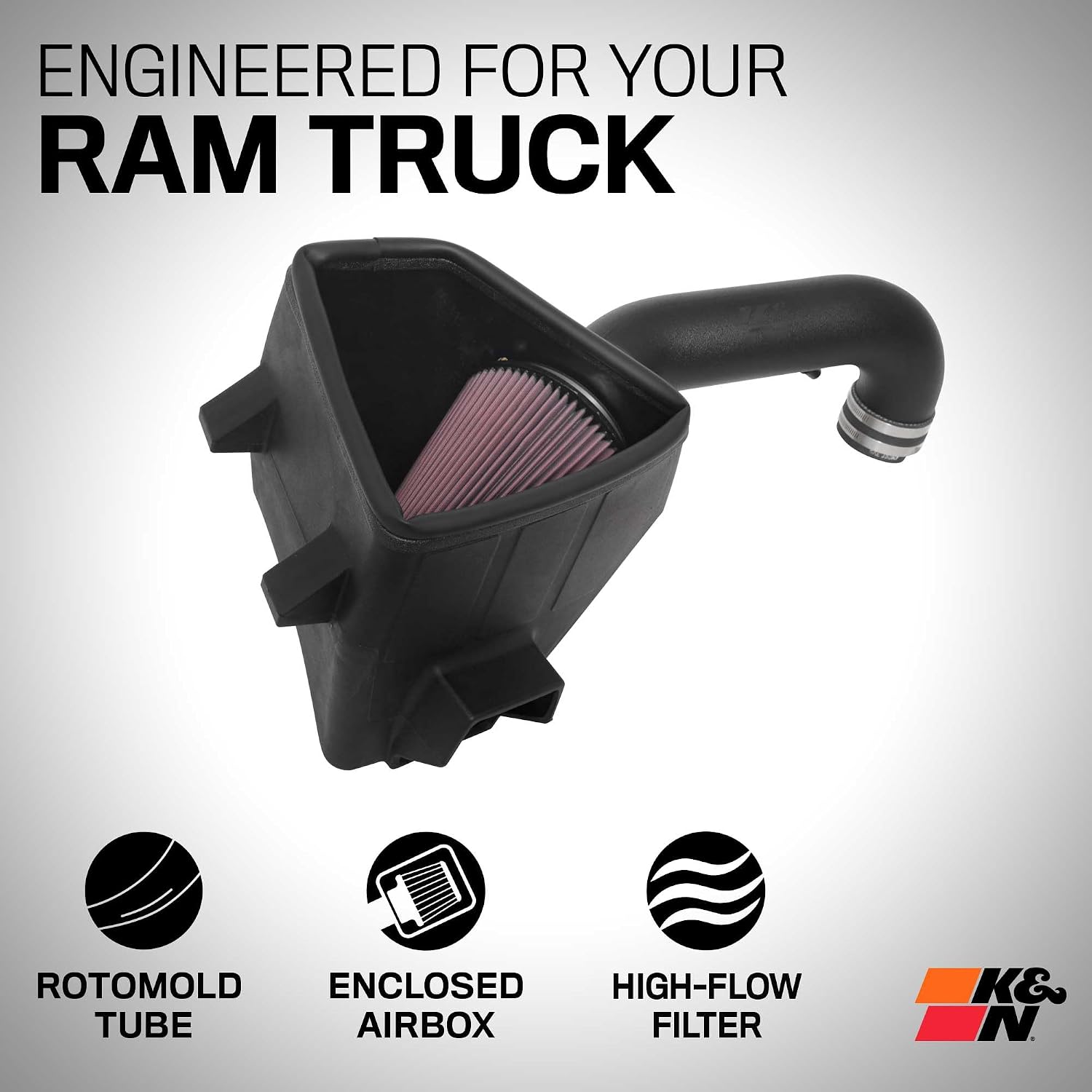
If you’ve ever looked under the hood of a Dodge RAM or a Challenger and wondered whether swapping the factory air box for an aftermarket intake is worth it, you’re in the right place. A cold-air intake (CAI) is exactly what it sounds like: a replacement for the stock intake system that tries to feed your engine denser, cooler air from a location farther away from heat sources under the hood. Cooler, denser air contains more oxygen molecules per cubic foot — and more oxygen means your engine can burn more fuel and make more power. That’s the theory. The practice — especially on Mopar’s diverse lineup, from the diesel-powered 5.9L and 6.7L Cummins in your RAM work truck to the naturally aspirated 5.7L or 6.4L HEMI in a Challenger or Charger — is more nuanced. This guide is going to walk you through what the dyno sheets actually show, where fitment gets tricky, and how to think about that heat shield your intake kit may or may not include.
| EDITOR'S PICKK&N Cold Air Intake System: Hig… | Mid-tierK&N Cold Air Intake System: Hig… | Budget pickK&N High-Flow Original Lifetime… | |
|---|---|---|---|
| Compatibility | 2019-2026 RAM 1500 | 1994-2002 Dodge/RAM 2500, 3500 | Chrysler/Dodge 300, Challenger, Charger |
| Type | Cold Air Intake System | Cold Air Intake System | Engine Air Filter |
| Filter Material | — | — | Oil Cotton |
| Washable | — | — | ✓ |
| Included Parts | Roto Molded | — | — |
| Price | $369.99 | $317.99 | $52.71 |
| See on Amazon → | See on Amazon → | See on Amazon → |
What the Dyno Sheets Actually Say (and Where the Marketing Math Gets Slippery)
Let’s start with the number every seller leads with: horsepower gain. On HEMI applications, manufacturer dyno sheets from AFE Power and K&N Engineering consistently show gains of 8–18 wheel horsepower on the 5.7L HEMI and 10–22 whp on the 6.4L HEMI under wide-open-throttle conditions, measured against a stock airbox on a load-bearing chassis dyno. MotorTrend’s published testing overview on bolt-on intake gains notes that the real-world spread is narrower once you account for dyno-to-dyno variation — call it 6–15 whp on the 5.7L as a defensible consensus range.
On the diesel side, Banks Power’s intake documentation for the 5.9L and 6.7L Cummins platforms tells a different story — and a better one for the buyer. Because the Cummins is turbocharged, the turbocharger’s compressor wheel is far more sensitive to inlet restriction than a naturally aspirated engine is. Every inch of water column (a unit of pressure drop, like measuring how hard the engine has to “suck” through the filter) you remove from the inlet tract translates more directly into maintained boost pressure and cooler charge temperatures. Banks’ published results on the 6.7L Cummins show gains in the 15–25 whp range under load, plus meaningful exhaust gas temperature (EGT) reductions — which matter enormously if you’re towing.
By the numbers — platform comparison:
| Platform | Engine | Typical Whp Gain | Primary Benefit |
|---|---|---|---|
| RAM 1500 | 5.7L HEMI (N/A) | 6–15 whp | Peak power, throttle response |
| Challenger/Charger | 6.4L HEMI (N/A) | 10–22 whp | Mid-range torque, sound |
| RAM 2500/3500 | 5.9L Cummins (turbo) | 12–20 whp | EGT reduction, turbo spool |
| RAM 2500/3500 | 6.7L Cummins (turbo) | 15–25 whp | Towing headroom, boost stability |
Source: AFE Power dyno reports, Banks Power intake documentation, K&N Dyno Certification Program results. Figures represent wheel horsepower on a chassis dyno vs. OEM airbox, wide-open throttle.
The honest footnote: gains are always measured at WOT. Your daily-driver experience will be more about throttle feel and response than raw peak power. On the HEMI platforms, most owners report the subjective improvement — the way the engine breathes more freely from 2,500 RPM up — as the part they actually notice. The dyno number is real; it’s just rarely what you feel every day.
Fitment Reality: Where Mopar Platforms Get Complicated
Dodge and RAM fitment is a land of seemingly small variables that cause big headaches. Here’s where practitioners consistently run into trouble.
The 5.7L HEMI in 1500 vs. the 5.7L in a Durango or Grand Cherokee The engine is the same; the engine bay geometry is not. An intake designed for a RAM 1500 (1500-body trucks) will not fit the WK2-generation Grand Cherokee or the third-gen Durango without modification, even though the throttle body and manifold are identical. Most major brands — AFE, S&B, Volant, K&N — publish separate SKUs for truck vs. SUV applications. Always cross-reference the year, cab configuration, and whether the truck has the 8HP70 automatic or a manual transmission if you’re on an older-gen build; the battery tray position differs and affects routing.
Gen 3 Hemi (5.7L) vs. the Apache/6.4L HEMI The 6.4L Apache HEMI found in the RAM 2500 Power Wagon, Challenger R/T Scat Pack, and Charger Scat Pack uses a larger throttle body and different resonator geometry. AFE Power’s Momentum GT series, for example, is available in separate configurations for the two engines. Mixing them is a common mistake in online ordering because the throttle body inlet diameter difference (90mm vs. 87mm) isn’t always obvious in a product title.
Cummins — the 5.9L vs. 6.7L divide The 5.9L Cummins was produced through 2007 in third-gen RAM 2500/3500 trucks. The 6.7L arrived in 2007.5 and continues today. Intakes are not interchangeable. Beyond that, the 6.7L has had multiple factory ECM/emissions hardware revisions — 2010–2012, 2013–2018, and 2019+ represent meaningfully different underhood packaging. S&B Filters’ intake catalog, which is among the most granular for Cummins applications, breaks these out by model year range. Banks Power similarly segments their Cummins offerings by truck generation. If you’re sourcing for a fleet or shop with mixed-year Cummins trucks, build a spreadsheet before ordering.
Hellcat and Redeye (6.2L Supercharged) — a different conversation The supercharged Hellcat Challenger and Charger require their own analysis. Because the 6.2L is force-inducted, the stock supercharger’s inlet is the constraint, and a traditional CAI tube repositioning matters less than heat management at the supercharger inlet. AFE and Mopar Performance both publish supercharger inlet kits specifically for this application. If you’re working on a 6.2L Hellcat, don’t apply naturally-aspirated HEMI intake logic — it’s a separate purchase decision.
Heat Shield Reality: Is Yours Actually Doing Anything?
This is the question practitioners stop asking too soon, and it’s the most important one on the HEMI platforms where the intake tube routes through a warm engine bay.
A heat shield’s job is to create a physical barrier between the intake filter and radiant heat from the engine block, exhaust manifolds, and power steering pump. The problem is that not all heat shields are equal — some are structural aluminum enclosures that fully seal around the filter and draw from a fender-duct or cold-air snorkel; others are decorative three-sided shrouds that leave the back of the filter fully exposed to underhood air.
Engine Labs’ published analysis of intake air temperature (IAT) differentials notes that a fully sealed intake feeding from a fender cold-air duct can maintain IATs 20–40°F lower than ambient underhood temperature during sustained driving — and that this temperature advantage is largely erased within a few minutes of sitting in stop-and-go traffic with a partial or open-back shield. The physics are straightforward: hot soak. Once you’re in traffic, a partial shield does almost nothing.
What to look for in a heat shield:
- Full enclosure with a foam seal on the lid: AFE’s Momentum HD series and S&B’s Cummins cold-air kits use this approach — the filter is enclosed like a box, with a snorkel or tube feeding from a cooler location.
- Dedicated cold-air source: Is there a tube or ram-air snorkel drawing from behind the headlight or inside the fender well? If yes, you’re getting true cold-air. If the filter just sits in a shield with no dedicated source, you’re getting a “short ram” setup that is largely drawing recirculated engine bay air.
- Mylar or foam versus raw aluminum: Many lower-cost shields use raw aluminum with no thermal insulation layer. Aluminum conducts heat readily. Better kits line the inside of the shield with a foam or Mylar thermal barrier.
The practical decision rule: on the diesel platforms (Cummins), the turbocharger’s sensitivity to inlet restriction makes even a partial-shield intake a meaningful upgrade over the stock box. On the naturally aspirated HEMIs, a partial-shield short-ram intake running in warm weather may deliver disappointing real-world gains because the IAT penalty negates the airflow benefit. If you’re in the Southwest or doing track days, prioritize full-enclosure designs.
The Decision Frame: Matching the Right Kit to Your Build
Here’s the if-then logic based on the research:
If you’re on a 5.7L or 6.4L HEMI Challenger/Charger and you care about real-world gains (not just peak dyno numbers): Prioritize a fully enclosed heat shield with a cold-air source. AFE’s Momentum GT series (approximately $350–$420 at mid-2026 pricing) and K&N’s 57-Series FIPK kits (approximately $280–$370) both offer full-enclosure designs for most HEMI Challenger and Charger applications. The AFE ships with a dry-flow filter that flows well out of the box; the K&N uses their oiled media, which owners report as slightly higher maintenance but favorable in dusty environments.
If you’re on a RAM 1500 5.7L HEMI as a daily driver: The short-ram vs. cold-air distinction matters more here because of hood-close clearances. S&B’s RAM 1500 kit and the AFE Momentum GT both address this with specific routing geometry. Budget $300–$450. At this tier, the gains are real but modest — treat it as a combination power upgrade and long-term filter maintenance upgrade (both K&N and AFE run lifetime washable filters) rather than a pure horsepower play.
If you’re on a 5.9L or 6.7L Cummins — especially if you tow: This is the highest-ROI application in the Mopar ecosystem. EGT reduction under tow load is a safety and reliability benefit, not just a performance one. Banks Power’s Ram-Air Intake (approximately $350–$500 for 6.7L applications) and S&B’s full cold-air kit for the 6.7L Cummins are the two most frequently cited by shop operators and fleet managers in aggregated reviews. Both provide full enclosure and genuine cold-air routing. If you’re stacking this with an exhaust and a tune, build the intake first — it’s the least-invasive starting point and will influence how your tuner sets fueling targets.
If you’re on a supercharged Hellcat platform: Do not apply standard CAI logic. Source an application-specific supercharger inlet kit from AFE Power or the Mopar Performance catalog. The gains come from reducing inlet restriction at the supercharger, not from repositioning a filter in the engine bay.
The through-line across all of these platforms: verify the heat shield is a true enclosure before you buy. A partial-shield kit at $180 may cost less, but owners on HEMI platforms in warm climates consistently report disappointment when summer IATs climb and the gains evaporate. The extra $100–$150 for a properly engineered full cold-air kit is the most defensible spend in this category.